
The car chassis, often the unseen foundation of your vehicle, acts as its fundamental skeletal structure. Think of it as the robust backbone upon which the entire car is built. This critical component provides the necessary support for the car’s body and serves as the anchor point for essential mechanical systems, including the engine, transmission, axles, steering mechanism, brakes, and suspension. It’s the unsung hero that bears the vehicle’s weight, whether it’s standing still or navigating dynamic driving conditions.
While the terms “chassis” and “frame” are sometimes used interchangeably in casual conversation, a technical nuance exists. The chassis is the complete load-bearing framework that houses the crucial mechanical components. The frame, on the other hand, is a structural element that can be fitted onto a chassis. However, modern automotive engineering frequently employs a unibody or monocoque construction, where the chassis and body frame are seamlessly integrated into a single, cohesive structural unit.
Why is the Chassis So Important? Its Key Functions:
The chassis plays several vital roles in a vehicle’s performance, safety, and comfort:
- Weight Distribution: It ensures the vehicle’s weight is evenly distributed across all axles and wheels. This even distribution is crucial for maintaining balance, predictable handling, and optimal tire grip.
- Crash Energy Absorption and Distribution: In the unfortunate event of a collision, the chassis is engineered to absorb and strategically distribute the impact energy. Features like crumple zones are designed to deform in a controlled manner, dissipating energy and protecting the occupants while minimizing damage to the passenger compartment.
- Support for Critical Components: The chassis provides rigid and secure mounting points for a wide array of essential systems. This includes the steering system, suspension components, brakes, wheels, engine, and transmission, ensuring their proper alignment and functionality.
- Structural Integrity and Balance: It acts as the central structural element that supports the powertrain (engine and drivetrain) and the steering system while providing a stable base for the suspension, brakes, and clutch mechanisms. This interconnectedness ensures the vehicle operates as a unified system.
- Noise, Vibration, and Harshness (NVH) Dampening: A well-designed chassis can significantly contribute to a smoother and more comfortable ride by effectively dampening road noise, vibrations from the engine and drivetrain, and general harshness experienced during travel.
The Diverse World of Car Chassis: Four Main Types
Over the years, various chassis designs have evolved to meet different vehicle requirements and manufacturing considerations:
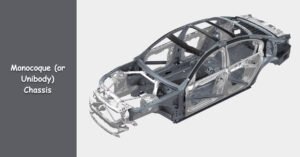
1.Monocoque (or Unibody) Chassis:
-
- Description: The term “monocoque” is French for “single shell.” In this widely adopted design, the body and chassis are engineered and manufactured as a single, integrated structural unit, much like an eggshell or an endoskeleton. The majority of modern passenger cars, SUVs, and hatchbacks employ this construction method.
-
- Benefits: Monocoque construction offers the best torsional rigidity among the common chassis types, leading to superior handling and a more connected feel for the driver. Its cage-like design generally provides better occupant safety in the event of a crash. Being lighter than body-on-frame constructions, it contributes to improved fuel efficiency and more agile handling. It also tends to offer a quieter ride and allows for more interior space due to the integrated design. Repairs can also be easier compared to some other designs.
- Drawbacks: The manufacturing process for a monocoque chassis is more complex and expensive, particularly for low-volume production. The integrated nature of the design can sometimes make repairs to damaged structural elements more involved.
2.Ladder Frame Chassis:
-
- Description: This is one of the oldest and simplest designs, resembling a traditional ladder. It consists of two long, robust beams (usually rectangular or box-section) connected by several shorter cross members.

-
- Benefits: Its straightforward design makes it relatively easy and cost-effective to manufacture and assemble. It offers high tensile strength and provides a very robust foundation, making it well-suited for heavy loads.
- Drawbacks: Ladder frames tend to be heavy and exhibit poor torsional rigidity, meaning they can twist and flex, negatively impacting cornering ability and overall handling. Consequently, they are generally not used in performance cars or most modern passenger cars and hatchbacks. You’ll primarily find them in trucks, buses, and other heavy-duty vehicles where robustness is prioritized over agility.
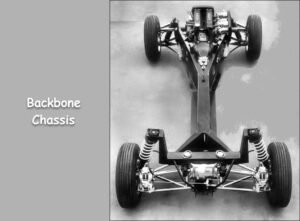
3.Backbone Chassis:
-
- Description: This design features a strong, hollow central tube, often referred to as the “backbone,” that runs longitudinally along the center of the vehicle, connecting the front and rear suspension systems. The driveshaft often runs within this protective tube.
-
- Benefits: The backbone structure offers better ground clearance compared to some other designs, which is advantageous for off-roading. It also provides a degree of protection to the driveshaft from undercarriage damage. Additionally, it generally exhibits better torsional rigidity than ladder frames.
- Drawbacks: Manufacturing a backbone chassis can be more complex and costly. A significant drawback is that if the driveshaft requires major repair or replacement, the entire chassis might need partial dismantling. Furthermore, backbone chassis designs are not particularly effective at handling side impacts. The iconic DeLorean DMC-12 famously utilized a backbone chassis.
4.Tubular Chassis (or Space Frame):
-
- Description: This advanced design involves constructing a three-dimensional structure from a complex network of interconnected hollow tubes, typically made of lightweight aluminum or specialized steel alloys. It can be viewed as a sophisticated, three-dimensional evolution of the ladder frame concept. This design is popular in high-performance and race cars.

-
- Benefits: Tubular chassis offer an excellent strength-to-weight ratio, providing very high rigidity for their relatively low mass. This results in superior handling and responsiveness, making them highly preferred for performance vehicles like race cars and high-end sports cars. The design allows for significant flexibility and customization in vehicle architecture. They also tend to offer excellent crash resistance due to their triangulated and interconnected structure.
- Drawbacks: The complex design and manufacturing process make tubular chassis challenging and time-consuming to produce, making them unsuitable for mass production or typical passenger cars. The intricate framework can sometimes make cabin access slightly more difficult due to higher door sills. Specialized welding techniques are also required for their construction.
The Building Blocks: Common Materials for Car Chassis
The choice of materials for a car chassis significantly impacts its strength, weight, cost, and corrosion resistance:
- Steel: Historically, steel has been the most prevalent material for chassis construction due to its inherent strength, durability, and relatively low cost. Various grades of steel are used, including carbon steel and steel alloys with different carbon content, tailored to specific strength and flexibility requirements. However, steel is heavier than some alternatives and can be susceptible to corrosion if not properly treated.
- Aluminum: Aluminum alloys are gaining popularity due to their lower density and good strength properties. This contributes to weight reduction, leading to improved fuel efficiency and enhanced performance, particularly in racing applications. Modern aluminum alloys often possess improved mechanical properties and better corrosion resistance compared to traditional steel.
- Magnesium Alloys: These alloys are even lighter than aluminum, making them attractive for high-performance vehicles where minimizing weight is paramount. However, they can be more expensive and may exhibit lower corrosion resistance compared to aluminum.
- Composites (e.g., Carbon Fiber): Composite materials like carbon fiber are becoming increasingly relevant in chassis design due to their exceptional lightweight and high strength characteristics. They also offer excellent corrosion resistance. While currently more expensive, their use is expanding in high-end and racing vehicles where performance outweighs cost considerations.
Looking Ahead: Future Trends in Automotive Chassis Design
The evolution of the car chassis continues to be driven by demands for improved performance, safety, and sustainability:
- Weight Reduction: The ongoing pursuit of better fuel efficiency and performance will continue to drive the adoption of lightweight materials such as advanced aluminum alloys and composites in chassis construction.
- Enhanced Safety Features: Future chassis designs will likely incorporate even more sophisticated safety features, including optimized crumple zones, seamless integration with Advanced Driver-Assistance Systems (ADAS), and the strategic placement of sensors for enhanced crashworthiness and occupant protection.
- Integration with Electric Powertrains: The rise of electric vehicles is necessitating chassis designs that can effectively accommodate large battery packs, electric motors, and related electronics while optimizing weight distribution, thermal management, and interior space.
- Modular Chassis Platforms: Automakers are increasingly investing in the development of flexible and modular chassis platforms. These standardized architectures can be adapted for use across multiple vehicle models, significantly reducing development time and costs while allowing for easier integration of different powertrains and technologies.